
How one Harps employee created a first-in-the-nation apprenticeship category
Sandy Stout
IT REALLY CAME down to stubbornness. Because from start to finish, it took more than a year of very hard work, and a whole lot of patience.
 I’m an HR Specialist for Harps, the grocery chain that got started way back in 1930 on Emma Street in Springdale, Arkansas. We became employee-owned in 2001, and today we have stores in eight states. We also have a dozen very new Arkansas-based meat-cutter apprentices, which I’m told is a national first. Before we started pushing this idea, the only meat-related apprenticeship categories recognized by the U.S. Department of Labor (DOL) were “chef” and “butcher.” If you think “meat cutter” and “butcher” are the same thing, then it’s safe to say you don’t know the DOL.
But I’m getting ahead of myself. The background to this story is that I knew Lonnie Emard, Apprenticely’s National Apprenticeship Director, from a previous job. Then when I joined Harps nine years ago, I encountered Lonnie again as he approached us about doing IT apprenticeships with Apprenticely’s prior incarnation, Arkansas Center for Data Sciences, or ACDS. That didn’t quite work out because our then-Director of IT, now VP, had already negotiated a successful IT internship arrangement with the University of Arkansas. But fast forward a few years: Apprenticeships became an increasingly important workforce strategy, grants and funding got broader and more numerous, and Apprenticely became a vital intermediary between employers and the DOL. And in mid-2024, Lonnie came back to Harps wanting to put those apprenticeship dollars to use in other categories.
We started out talking about three very different occupational categories, including pharmacy tech and cake decorator. For various reasons, neither of those panned out—at least they haven’t yet. The remaining occupation was that of meat cutter, and I was all in on making that work. Partly that’s because I know there are a lot of high school grads here in Arkansas who want to get jobs here but can’t get their foot in the door. Just like with getting their commercial drivers’ license, Harps wants drivers with at least three years of experience—and I totally get that. But how are you going to get experience if nobody will give you the chance to get experience? So when Lonnie and I started zeroing in on the meat department, I got excited. Fortunately, our VP of Meat and Seafood recognized that we had a real opportunity to address a workforce need. “Let’s give it a try,” he said.
But getting from his yes to me telling this story took about 15 months—and, as you’ll soon see, they weren’t just everyday run-of-the-mill months. A whole lot of unusual stuff was going on.
Including me getting to know the Department of Labor. The DOL has a website of approved job descriptions. It’s called O*NET, and that’s where people like me who have a new apprenticeship category in mind can check to see if it meshes with any of the job descriptions the DOL has given its blessing to. That’s when we found out that “meat cutter” was a no-show.
So what did we do? We rolled up our sleeves and started a conversation with the folks at the DOL. I’ll spare you the details, but, after quite a bit of writing and calling back and forth, we were told that if we could “tweak the meat-cutter job description within 20 percent” of the butcher job requirements, we could use the butcher description for the meat-cutter apprenticeship.
So we started tweaking. But when we submitted our job description, the DOL didn’t approve our 20% change of the butcher job description, so we had to go back to the drawing board and write one specifically for meatcutter, starting the process all over again. Meanwhile, guess what happened next: The government shut down, adding more months to our wait. Then we had some lag time due to acquisitions, then there was peak shopping season, then vacations and Christmas, then delays between the state of Arkansas and workforce development, and then delays with the Department of Labor being available to field questions, etcetera, etcetera, etcetera.
This is where my stubborn streak paid off. Other grocery chains, which I won’t name out of professional courtesy, tried to get apprenticeships approved during this bumpy period and just gave up. I’m proud to say we stuck with it.
***
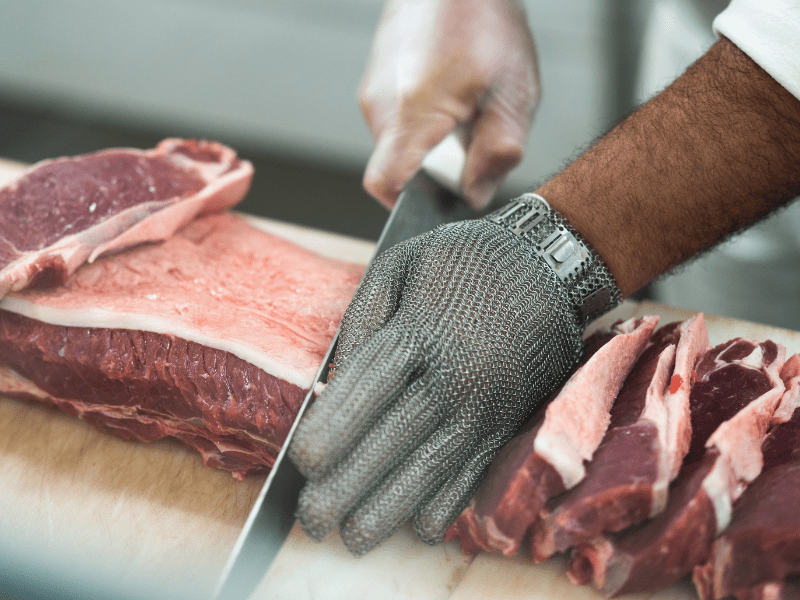
BECAUSE OF US, now any grocery chain in the U.S. that has an actual meat cutter in-house can sign up for a meat-cutter apprenticeship. We also negotiated the length of the apprenticeship, bringing it down from the DOL’s three years for the butcher category to two years and three months for the meat cutter. That’s 4500 hours of paid on-the-job training, along with 288 hours of related technical instruction in such areas as the preparation and cutting of meat products for sale; the weighing, labeling, and pricing of meat products; food inspections; customer service; and food safety.
That’s just the DOL summary of the apprenticeship. Up close and personal, this intense training involves learning how to use some very serious equipment, whether that’s the very sharp knife or the kind of electric saw that we have in all of our stores, a machine that will cut through bone and frozen meat. This machine leaves some waste, which these apprentices must learn to minimize, because waste affects our bottom line. They also learn how to make the most of every usable piece by packaging it as stew meat or grinding it into quality hamburger meat. In addition, they learn to work with all the different kinds of meat we sell, from beef to lamb to pork to chicken, and even seafood.
And with meat being increasingly expensive these days, these apprentices have to know how to make the right cut according to what the customer asks for. For example, if I order a pork steak two inches thick on the bone or off the bone, they have to learn to fill that order as second nature, and to treat any waste with appropriate resourcefulness.
After the 27 months of training, these meat-cutter apprentices will become journeymen meat cutters, just like a journeyman electrician. From there, the future is what they want to make it.
So what kind of person becomes a meat cutter at Harps? The truth is, 95% of the time a person doesn’t apply saying, “I’m a meat cutter.” What we do is hire somebody to be what we call a meat clerk. That means they do the stocking of the meat and the cleaning and sanitizing of the meat department so it doesn’t develop salmonella.
Once they’re onboard, we can see if they’re team players and they follow directions and they want to get promoted. And if they’re okay working in that very cold environment, they can grow their careers right there in the meat department. This apprenticeship also helps ensure that we can have a strong pipeline of future meat cutters instead of having that age-old occupation die out. And as I said earlier, we now have stores in seven states besides Arkansas—Kansas, Oklahoma, Missouri, Tennessee, Kentucky, Mississippi, and Louisiana. Different states have different relationships with the DOL, and right now Lonnie Emard is exploring the meat-cutter apprenticeship situation in the seven other states. By this time next year, I expect we’ll have ignited a great fire of meat-cutter apprenticeships across a significant region of the nation.
I also want to say one more thing about these meat-cutter apprentices. Our stores are mostly in small towns in rural areas, and that’s another reason I was so driven to develop this opportunity. As one of our Apprenticely colleagues says, there are a whole lot of young people in our towns who don’t see themselves going to college to become an engineer or a doctor. They grew up hunting and fishing in their own familiar stomping grounds, and they want to stay local. But where can they go to make a decent living? Well, how about this: The meat-cutter position is in fact the highest paying non-manager job in the entire Harps grocery store, which tells you about the importance we place on this position. And if they get really ambitious, Harps has many opportunities for growth: department manager, merchandiser, and beyond.
But if getting to stay local and earn a good living still isn’t enough, remember what I mentioned a few paragraphs back: Harps is an employee-owned company, and people who work here receive stock based off our profits—none of which comes out of their paycheck. It all comes out of our company’s proceeds.
All the more reason for our meat cutters to make the most of every bit of that precious meat.
_______________________________
For more information on meat-cutter apprenticeships, contact Sandy Stout, HR Specialist, at sandys@harpsfood.com.