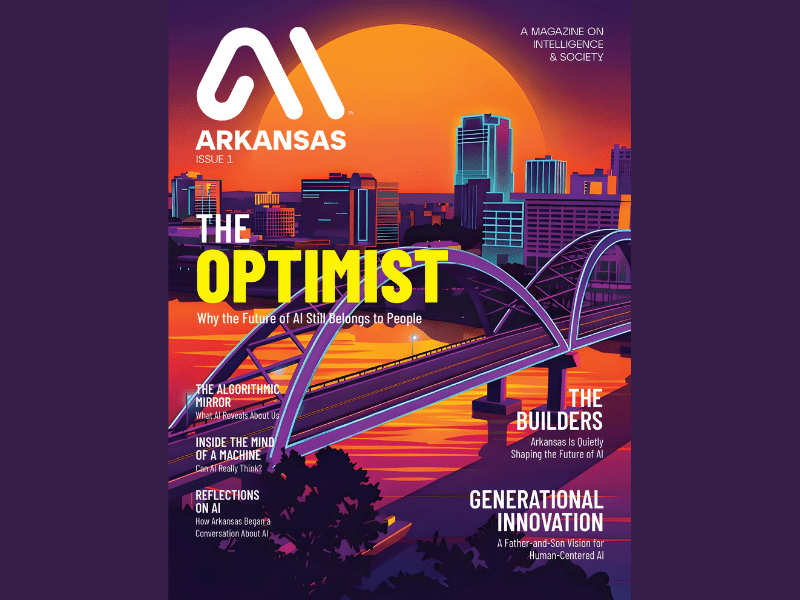
FOR MORE THAN a year now, Matt Olson has spearheaded an ambitious monthly Little Rock A.I. meet-up group, an effort dedicated to exploring the good and the bad of this force that has changed all our lives. When we got word that he’s recently taken this exploration to a whole new level—with the publication of A.I. Arkansas Magazine—we invited him to be our interviewee for this month and to tell us all about it.
_________________________________
When did you start working on this magazine and why?
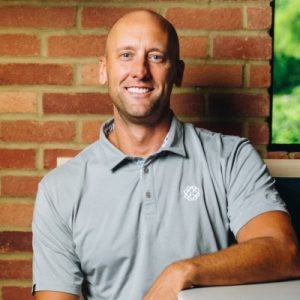 We started working on the magazine the middle of last year. It came out of our monthly A.I. meet-ups, which we launched in April 2025. Those get-togethers are open to anyone interested in learning about, discussing, or responsibly applying A.I. in business, education, creativity, and the public sphere, and these discussions have just snowballed, because A.I. has become omnipresent in everyone’s life. It’s overwhelming. And that’s exactly the word because where do you go to talk about it, to learn about it? You can only do so much online and on LinkedIn, and you’ve still got to live your life too.
The reason I wanted the magazine is to make it more tangible, because when I just talk about A.I., it sort of goes over people’s head. But when I hand them a magazine, suddenly they’re like, wait, this is real. So I think this gives us a way to bring people who are brand new in regard to A.I. together with those who are advanced in it, and in an environment where they can talk about it and be optimistic or pessimistic. It’s both. I’m not selling A.I. But we all know we’re in this together, and we need to discuss it and learn about it and hopefully figure out ways for it to help humanity.
Our editor, Kody Ford, had started his own magazine, The Idle Class. He’s a cool guy and a hard worker and he had time to help me put this together. So he really did a lot of the legwork with interviewing and getting the right people and putting together a piece that’s really amazing. As for A.I., we used it for research and for revising articles, as well as for running hundreds of creative concepts, both inside the magazine as well as for the cover. We printed over 5,000 copies, and UALR handed it out to every student they can hand it out to. So we got UALR’s attention, and UCA’s. And now folks from Northwest Arkansas are coming down here to our monthly meet-up events. They’re going, “We need this up there.” Imagine that.
The movement is here, the gravity is here, and we’re at a tipping point. So I was just like, “We need a magazine about A.I.” And we did it and people want to be in it and people want to read it. When I hand it out, they’re like, “A magazine for A.I.? Wait, and it’s in Arkansas?”
Let me ask you some magazine nuts and bolts. What about the frequency? How often are you planning to publish?
I’m just trying to see how it goes right now. If I could find more advertisers, then I’d do another one. Outside of that, it’s proof that I can create magazines and printed material at a reasonable cost, so it’s something I can produce for different clients. As for this particular magazine, I’m curious as to whether AY or Arkansas Times or Arkansas Business—someone with a sales team—would be interested in an existing audience, an already made brand, and picking it up and using it as an insert.
Well, let’s talk about A.I. itself. How has your company, Matmon, incorporated A.I. into your work?
We’re using it to better understand our client’s assignments, to make sure we’re all on the same page upfront by really thinking it through. A lot of times it makes people step back and go, “Wow, I was about to make a big mistake now that I look at it from the customer’s perspective or the ideal customer profile.” So I think A.I. really helps us figure out what we want to do before we go to market, before we generate content, before we buy ads, before we build a website.
I’m incorporating it into the entire process from talking to the client to taking all of our notes and running that through our systems so it knows what we’re trying to do for our clients. That’s a really fast way for me to produce a deal, an estimate, a mutually beneficial agreement. I think it’s making deals a little more transparent.
Speaking of transparency and magazines, some magazines have gotten in trouble by not being transparent about using A.I. Sports Illustrated got nailed because they put somebody’s byline on an A.I. piece and even included a bio and photo of the so-called writer, who didn’t actually exist. So what’s your philosophy on the responsible use of A.I. in the marketplace?
No one’s really said what’s legally or morally okay, but I do think it gets sort of muddy if you give A.I. your thoughts and it brings back a written piece and you don’t even read it, you just let it go. We have to realize that that’s going to happen, and certain people are going to start being understood as being “that person” versus the one who edits what A.I. creates and makes sure it reflects their true feelings before putting it in front of the public. But I think the real issue is whether it’s misleading. If A.I. helps someone get to a better result faster, and a real person is still guiding, editing, and standing behind it, then the question becomes: When does disclosure actually help the audience?
In my particular case, as a longtime magazine editor and writer of books and magazine articles, I have great respect for writers and illustrators and graphic designers. That said, I’ve used A.I. for the Apprenticely newsletter some, just to experiment with it and learn what it can help us do—but I’ve always acknowledged its use in the newsletter. And even that has prompted a bit of blowback: “Hey, you guys are in the business of getting people jobs and here you are using this system that takes jobs from creative people….” It’s something to think about.
But you’re also using this system—A.I.—to get people jobs…. Should the mission be that you can’t use A.I. to get people jobs? Is it part of the mission to keep it organic and never use computers?
Well, what do you say to your creative team—artists, graphic designers, et cetera—about this new tool that could make them extinct?
I tell them that we have to use it. We just have to use it and we have to find a way to add it plus us. But if you want to stay in the bespoke hand-sewn, hand-done design kind of sector, fine. You can also continue to grind and make your own bread by hand, and you’re right, we’re losing so much value by just buying this white bread that’s got no nutrition in it.
Listen, I don’t see a way around using A.I. I mean, agencies like mine are already seeing the market change because clients can now do certain things on their own. That means our value has to move upstream, into strategy, judgment, implementation, and helping people use these tools well.
Honestly, I got involved in all of this thinking, How can we use A.I. to help people? I think the biggest good we can do for people is to help them feel comfortable in their own minds and work with other people toward something meaningful. To me, that’s a bigger power than all the scary A.I. robot stuff, bots making their own decisions and driving cars around. And that’s really why I started organizing these group meetings. We’re all bumping into this, so let’s come together and have some food and drinks and relax and talk about it. The magazine was just a way for me to extend that out further, to get more people to the events.
You mentioned earlier that we’ve reached a tipping point with A.I., and I believe you’re right. We just passed graduation time, so it’s no surprise that a lot of people just getting out of school are speaking out about the force that’s revolutionizing the job market. Even Pope Leo felt obligated to talk about A.I. and the need to use it to help humanity. It is a time of great opportunity but it’s also a scary time for people. So it seems to be a negative tipping point too. What do you say to all of this?
I think whenever there’s change, dramatic change, especially fast change, it’s going to just rock the system, being good for some and bad for some. And this is probably the biggest change we’ve ever seen, this intelligence being given to us at a level that we’ve never had it given to us before—and given to all of us, not just the elites. So we have no idea what’s going to happen. But I think there’s going to be so much good that comes out of it when you give all these people that have not had these resources enough time to truly start leveraging them, whether to feed people or cure cancer or help people with their hip problems after they hit age 50. I mean, I think humans are going to take care of it. I have faith that the good will surpass the bad—but the bad is going to be there too, in every aspect.
I was particularly struck by a quote in your magazine’s lead piece, “The Optimist,” about researcher and academic Mariofanna Milanova. “What gives me hope,” she said, “is that A.I. can amplify empathy and creativity.” And she goes on to say, “When guided by ethics and inclusivity, A.I. becomes not a threat to humanity, but a partner in expanding human potential.”
To which I would remind you that Elon Musk, who was intimately involved in developing A.I., famously said, “Empathy is the fundamental weakness of Western civilization.” I also wish I felt more comfortable believing that the people we would look to for creating guardrails for A.I. are truly interested in either empathy or inclusivity. I know I sound like a Luddite, which I’m most certainly not. But how do you think Ms. Milanova’s hope for A.I. is going to turn out the way she wants it to?
I think it’s like a race, a race for humanity. It’s a race for who’s going to define and shape our future. I don’t want to wait. And I think it’s a time of don’t wait to be told exactly what to do, because those times are over. Maybe we hit a peak where it felt like we had everything figured out, all our professions, everything pretty locked in. It was almost like we were in a class system and this is blowing the class system out again. Now all those things don’t matter. Now let’s see who can show that they’re not going to just sit around and wait and complain.
I’ll leave you with what I think is an interesting passage from Ezra Klein in the New York Times. “The actual thing we should worry about,” he said, “is leaving A.I. entirely in the hands of major corporations who only invest in what has a proven business model. Because the public has no clear vision of what it wants the technology to achieve, the massive societal benefits—such as accelerating drug discovery, curing diseases, solving ecological problems, and improving public services—may never be realized….If the public sector doesn’t articulate a bold, active plan for how A.I. can help citizens, the technology will never be steered toward the public good.”
Yes, I recently heard an example of making A.I. tools available free to healthcare providers, and that was the first time I thought, “Oh, yeah, let’s make sure there’s no barrier of entry for people who are in the business of helping our community.” And most everyone has a phone today, so there’s no reason everyday people can’t access even the free version of A.I.
Making sure the public is using it is going to start in the school system, and you can see how fragmented that is. If teachers are going to continue to just be worried about trying to keep people from cheating, then that’s not where we’re trying to go. I guess what I’m saying is, at what point are we all going to collectively go, “It’s us plus A.I.?”
__________________________________
More details about Matt Olson’s monthly A.I. meet-ups are available at InTheRock.ai.