
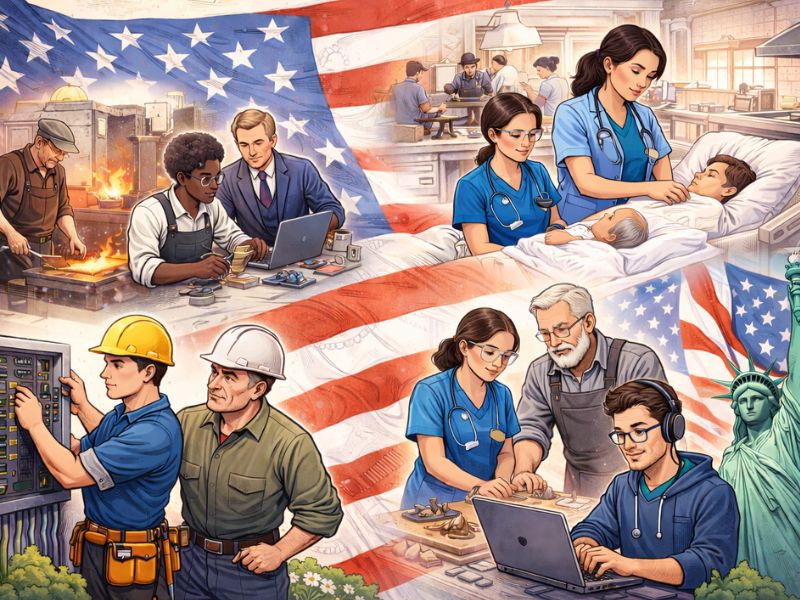
115 years of workforce in progress
FOR MORE THAN a century, apprenticeships have helped U.S. workers build careers and live fulfilling lives. For this special issue of the Apprenticely newsletter, we commissioned ChatGPT to produce a timeline showing how the concept of Registered Apprenticeships (RA) grew from a trade-focused training method into a broadly accepted U.S. workforce strategy.
–––––––––––––––––––––––––
1910s–1930s: Foundations and federal legitimacy
1911—First state “registered” system (Wisconsin). Often cited as the first formal state apprenticeship registration framework in the U.S., helping set the template for later national standards.
1937—National Apprenticeship Act (“Fitzgerald Act”). Establishes the federal Registered Apprenticeship system and authorizes the U.S. Department of Labor to promote and safeguard apprenticeship standards. This is the core legal foundation still referenced today.
1940s: Rapid scale-up (wartime and industrial demand)
Mid-1940s—Major growth in programs. DOL history notes thousands of RA programs operating nationally by the mid-1940s—an early proof of scale and utility in training pipelines.
1970s: “Equal access” becomes part of quality and acceptance
1978—First modern-era federal EEO rule for apprenticeship (29 CFR Part 30, earlier version). This era marks a shift: Apprenticeships aren’t only about skill standards, but also about fair access and nondiscrimination, which influences public legitimacy and employer participation. (The 2016 update explicitly references the 1978 prior rule.)
2000s: Modernization of the core RA rulebook
October 29, 2008—Major update to the RA labor standards regulations (29 CFR Part 29). DOL describes this as a modernization framework for a 21st-century apprenticeship system.
2010s: Expansion beyond construction/manufacturing into “new economy” sectors
July 22, 2014—Workforce Innovation and Opportunity Act (WIOA) signed. WIOA becomes a key workforce-system statute that states and regions use to align training dollars and strategy—important for normalizing apprenticeship as a mainstream workforce tool.
2014–2015—“ApprenticeshipUSA” national push begins. The Obama Administration publicly sets a goal to expand/double apprentices and elevate apprenticeship across industries.
September 2015—$175M federal investment (American Apprenticeship Initiative/grants). A major signal of “bipartisan-ish” mainstream economic acceptance—designed to expand RA into sectors like healthcare, IT, and advanced manufacturing.
November 2015—First-ever National Apprenticeship Week. A public-facing milestone: Celebrating apprenticeship nationally helps normalize it for employers, educators, and jobseekers.
December 19, 2016—Updated EEO rule for apprenticeship (29 CFR Part 30). This modernizes equal opportunity requirements and enforcement expectations for RA sponsors, reinforcing the idea that “quality apprenticeship” includes both training rigor and fair access.
June 15, 2017—Executive Order 13801 (“Expanding Apprenticeships in America”). A high-visibility federal push to expand apprenticeships, including exploration of alternative quality frameworks (e.g., industry-recognized approaches).
June 24, 2019—DOL highlights growth and launches/advances Industry-Recognized Apprenticeship initiatives. Shows continued federal emphasis on scaling apprenticeship models.
2020s: Apprenticeship becomes embedded in major industrial & climate policy
November 30, 2022—Treasury/IRS issue initial guidance tying big clean-energy tax incentives to Registered Apprenticeship (and prevailing wage). This is a huge “acceptance” milestone: Apprenticeship is no longer just workforce policy—it becomes part of tax policy and industrial strategy, influencing megaproject labor planning.
August 29, 2023 + June 18, 2024—Continued IRS rulemaking and final regulations on prevailing wage & apprenticeship requirements. These steps further operationalize how apprenticeship is used to unlock higher-value credits/deductions.
January 17, 2024—“National Apprenticeship System Enhancements” rulemaking published (Federal Register). Signals continued modernization efforts and debate over what requirements best balance quality, access, and program flexibility.
February 7, 2025—CRS report summarizes the federal role and recent developments. A good “state of the system” marker showing how apprenticeship has matured into a recurring congressional policy focus.