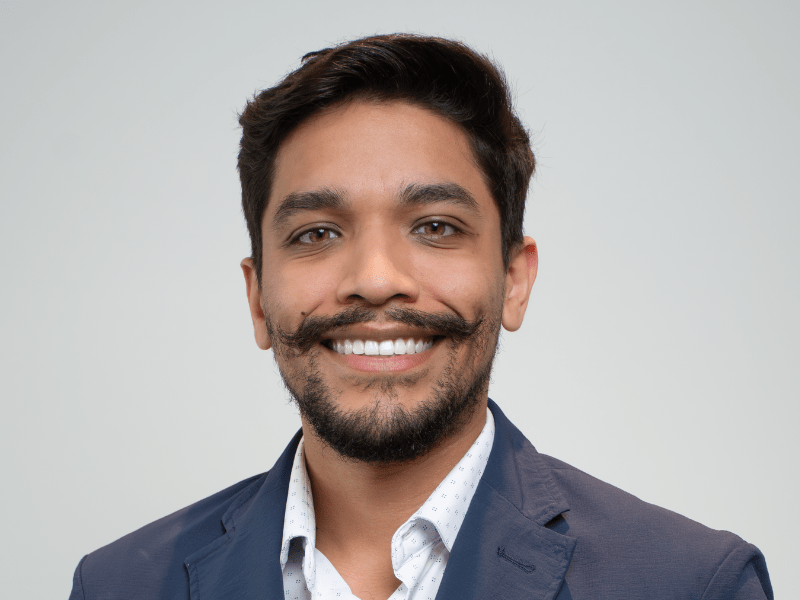
MEET SERGIO BONILLA
Age: 30
Hometown: Springdale, AR
Apprenticeship: UAMS Institute for Community Health Innovation
MY BACK STORY
I was born in El Salvador, in Central America, the oldest of three sons. We lived in San Salvador and I went through high school there, graduating as a technician in electronics. It’s one of the career paths that people traditionally do in these countries, and they try to prepare you for the workforce from high school.
We moved to Springdale in 2014, the last of our family to make it here. I have a well-established, extensive family in Northwest Arkansas—between 80 and 120 relatives. One of my aunts was the first one to move here about 40, 45 years ago. You know the mall on highway 71 on the way to Fayetteville? She moved here when there were cattle grazing on that land.
Honestly, my nuclear family came to Arkansas out of circumstantial luck really. Back in El Salvador, we were having to move from town to town and state to state because I was at the age that a lot of criminal gangs in my area were seeking to have me join them. My mom had put in the papers for us to come here legally way back in 1999, and while we were waiting to hear about that, we had to flee constantly. We once changed cities three times in a month, trying to keep the gangs away.
But every time we would move into a new town, the locals would know that new people had moved in and they would start trying to get me. So right at that window of time after more than a 14-year wait, the papers actually came: “We approve you,” they said. “You can come as a permanent resident.” And so we all moved to Springdale on February 14, 2014. I turned 18 years old on the 22nd here.
One of the reasons we moved specifically to Arkansas, aside from family, is that my dad had lots of health issues, and one of the doctors in El Salvador referred us to Little Rock UAMS for him to try to get this certain surgery that only two or three surgeons in the United States could perform. And one of those surgeons was at UAMS. So, funnily enough, my story with UAMS started as me and my family seeking healthcare from the hospital.
MY WORK LIFE (Part One)
My dad wasn’t well, and I was the oldest son, so I needed to get a job fast. Maybe a week after my birthday in 2014, I got hired at a large poultry plant. I was working in shipping and receiving. I walked three miles there and three miles back during all seasons, because I didn’t have a car. So what else was I going to do?
And I was working on learning English at the same time—nobody in my family knew a lick of English when we got here. But within six months, I got a leadership position at the poultry plant because I knew how to problem-solve a lot of things that they were just having issues with in shipping and receiving. And in a year and a half, I had learned enough English that I felt that I could do something else, because I didn’t really like the job itself.
I grew up surrounded by the idea of community, of volunteering. My grandpa was one of the first people in El Salvador to have an actual TV show, so he was a bit of a celebrity. He would dress up like a clown and do volunteering in senior centers. He also had a ventriloquist act. For his TV program, he would sit this puppet on his lap and have a conversation with him, and it was broadcast across El Salvador.
My dad, who worked as a Customs agent, sort of followed in my grandpa’s footsteps. He did photography, and he did some volunteering too. The idea of wanting to be around people, to help people, I learned from my dad. While my mom was reserved, my dad could stop anyone in the street and talk to them for hours and hours. And I witnessed that for so long that it just became a part of me.
I know how to program computers. I know how to do a lot of different things that have nothing to do with what I’m doing right now. But it’s a very lonely career path. So I wanted to find a job where I was working with people.
MY WORK LIFE (Part Two)
I found myself with a chance to work on contract as a caregiver at a permanent support provider. They trained me for some time and then I started to take care of different people, providing on-the-clock assistance to clients on the spectrum.
MY WORK LIFE (Part Three)
Then they couldn’t sustain the position anymore, and also my dad was needing a lot more care, so I had to stop working there. Fortunately, I found flexibility as a custodian with a public school district. Again, it was really good job because I was with kids all day. As a custodian you do clean, but during the day you’re just another person watching the kids, helping out with the dynamics of everything. I also learned even more English there because the different teachers saw that I wanted to learn and would take the time to teach me.
I also got a job at an auto parts store around this time, where I worked as the front face of the store, meeting the customers. In these jobs, they were good to me because they knew I had to take care of my dad.
MY WORK LIFE (Part Four)
Then in 2018, I got a job at a community health center. That was me going back to something related to healthcare. Again, the word community, I kept dragging it along. I saw the job offer. I was a sterilization technician—that was my way in. But they were also looking for someone who could do community advocacy care for clients in the dental offices that they had, and by that point, I knew English. What they really needed was an interpreter, and I became the interpreter.
So there I did care coordination, advocacy, insurance checks and whatnot, working with people, explaining treatment plans to them in Spanish mostly. But they still needed me to do the sterilization tech work at the dental clinic they had, so I was doing both jobs at the same time. By the end, I was basically doing almost three different jobs—checking insurance, keeping the instruments sterile, and care coordination. I could see myself in those people all the time. I knew they were struggling because they couldn’t understand the language, and it reminded me of when I couldn’t even go to McDonald’s and order something because of my lack of English.
So I did my best to help them all. I learned medical language terminology to explain, in both English and Spanish, what was going on. And in that space I met my first mentor, a DDS of Cuban origin. Her name is Sara Gardner. She saw that I wanted to do this type of job, so she got me from the sterilization technician job to more of a care coordination and advocate position. She was like, “Man, you know the English. You know the Spanish. Just help people!” She basically coached me into bringing myself out of my own shell too, to embrace the fact that I could create capacity in people to understand the things they needed to do to meet their healthcare goals.
Then COVID hit, which greatly affected the work at the community health center—after all, I was working with people’s mouths. I got COVID maybe six, eight times during that period of time, and I could feel that my body was just not taking it. So I had to make a choice. They wanted me and encouraged me to keep coming to work, but at the same time there were fewer incentives. I was already out of my sick days and they couldn’t offer me any more. So I had to stop working there.
It was about this time that my dad passed. We did everything that we could, and they came and did the surgery. But he didn’t live through it. His body just couldn’t take it.
MY WORK LIFE (Part Five)
For a few months during the COVID shutdown, I was at home trying to find something to do, and I found a corporate job opportunity working with different companies and billing. So I helped people with billing issues. It was just me and a computer, but still talking to people.
But I never stopped looking for something related to healthcare, so while I was working at the corporate job, I started to trying to find the kind of work that I did there but on the medical side.
MY TURNAROUND MOMENT
Then, on a Facebook post, I found a notice from UAMS Institute for Community Health Innovation about a position called a Contact Tracer. It was still during COVID and they were needing people who spoke more than one language to help contact trace.
Let’s say you got sick with COVID, you don’t know from where, but you know that you had five or six people around you that week and you’re concerned now for their health. So from my phone, from my computer, from my house, I would just contact the people you’ve been with and inform them, “Hey, you’ve been in contact with someone who had COVID. If you’re available this week, we can bring you into one of our mobile sites to get tested.” So I did that—and that was my way into UAMS.
But as COVID got worse, the director of this Institute that I now work in, Krista Langston, offered me and others the opportunity to start working out of the actual Northwest Hospital site as a contact tracer. And they started to do a mobile health clinic and they would suit us up from head to toe. We did it during the spring, summer, autumn, and winter, but we were all covered up, masked and everything, because we couldn’t risk having these people who might have been exposed to COVID actually coming into the hospital. So we met them at the mobile clinic and gave them tests, vaccines, masks, and so on.
I did that as a contract person for maybe for a year. And then Krista offered me an actual position as a “care advocate/community health worker.” They were figuring out the theme of the position still, but they knew that it had to be community-health-work related. “You’re working with people to help them meet their healthcare goals by going out and about doing outreach, doing events, finding people that need healthcare and connecting them to the resources they need….”
So I was like, yes, I want that job!
MY JOB/APPRENTICESHIP
I’ve been at the UAMS Institute for Community Health Innovation for more than five years now. The idea was to invest in community health work and use community health workers to make research more community-based. I’ve been part of different research studies that had to do with diabetes in rural health, and that has special meaning to me because my dad had diabetes. So I would find participants, enroll them into our programs after pitching it to them. At the same time that I was doing those data collection sites or whatnot for the research study, they would also ask me to help that person get into a better state of health.
We want to take a more holistic approach to their health by giving them education, care coordination, and creating capacity in these people to get into the mindset that they need to take care of their health.
So I started to have cases, and became a case manager at that time too. I was also a data collector for research purposes while at the same time a community health worker who had clients. We would go in anywhere in this tri-county area of Arkansas and do health events and find people, give them a healthcare screening, and help them understand their results with a nurse. I was also the interpreter now and I would interpret what the results were and then give my pitch to the people: “Okay, so this is what it is. Now, brother, do you want to be healthy? Would you like to get your diabetes in control? Would you like to understand what hypertension is?”
I’ve done a lot of events, a lot of research, three different research studies and care coordination at the same time. UAMS has helped me develop myself into a community health care professional. I was already doing the job that I wanted. In fact, since the moment they offered me the job, I have never “worked” a day in my life!
As for my apprenticeship, the supervisors here kept providing me training on all of these different concepts that make a community health worker. And at one point a supervisor named Bonnie Faitak saw something in me that I didn’t see myself—the potential for being a mentor. Mentoring people on the work that I was doing, facilitating classes, teaching people to become community health workers.
That was probably three years ago. And they offered me the job of doing this training for community health. So they turned me into a mentor. I got certified at ARCHWA, the Arkansas Community Health Worker Association as a CHW.
But even with that certification, I still wanted to have some guidance that I wasn’t just winging it. So at one of the Community Health Worker Association summits, I met Apprenticely’s Dawn Smith, told her my story, and said I was basically seeking ways to keep expanding my knowledge in mentoring. “We have this Community Health Worker apprenticeship that you could get,” she said. “Your employer just has to approve.”
Apprenticely already partnered with UAMS, so I pitched it to my direct supervisor, Rosalinda Medrano Green. “If we can find someone here to do the mentorship for you, we’ll go ahead and do it,” she said. So I went through the apprenticeship with Apprenticely and gained more understanding of my role and more validation of my skills. I finished it in about eight months.
Now I’m a Senior Community Health Worker at UAMS Institute for Community Health Innovation. I’m also trying to pursue more of a professional academic path, pursuing my college degree at the University of Arkansas—something that I never thought I would be able to do. I’m doing as much as I can online and then as much as I can physically as well. And UAMS has been totally supportive of this effort.
I couldn’t be more grateful. And at the same time, they’re giving me a job that I already wanted to do!